OK, I kick it old school. I get a bit freaked out when I see students in class taking selfies. Or I get a bit annoyed when my students are constantly on their phone, and trying to hide it from me. I recently reprimanded a student when I saw her making duckface while taking a selfie...she was supposed to be finishing a test! But according to Getting Started with Snapchat in Your Classroom, our students are using Snapchat and we should be ok with that. In fact, we should look for ways to use Snapchat as a learning tool instead of trying to exclude it from our rooms.
Snapchat is essentially a way to tell stories. So although your story doesn't need to be tightly scripted, there are some things to think about before plunging in. Think about what you want your story to say, and how you say it. Make sure to understand what your school or district policies are regarding social media. And perhaps developing some written guidelines you can share with your students will help you and them have a purpose and a clear direction for usage. Basically your use of Snapchat in the classroom is the story of your classroom, your way to share information and communicate with others about what's happening with your classes. When I think about using Snapchat this way, I get less tense and actually it sounds like fun.
In the article there are five easy ways to try to incorporate Snapchat into your classroom:
1. as a reminder, for upcoming tests, assignments, activities, etc.;
2. if you come across some interesting or real-world examples of content;
3. drawing diagrams or annotations of text; (This would be awesome for me. We use text codes for annotating texts, I could Snapchat the text with the text codes I used to annotate.)
4. as a study session, to share some key information about an upcoming test or assignment;
5. as professional development - you can see how other super users of Snapchat are using it.
Snapchat can be a very powerful learning tool if you allow your students to take charge of the use of Snapchat in your class. This is an authentic way to model and teach responsible digital citizenship. It encompasses the 4 C's of the 21st Century: Students are using critical thinking in terms of what to post. Students are communicating with other students and creating content. Students can collaborate with each other before they post in terms of ideas and pictures.
It's a big "if" though!! I googled students snapchatting in class, and wow, I came up with some really inappropriate stuff. If you want your students to use Snapchat in class, you've got to be really careful. This goes back to having guidelines but also following through and paying close attention to what students are doing. Maybe one of the jobs in your classroom can be the Snapchatter, and assign students on a rotating basis.
According to an article on Mashable, (Slightly sensationalistic news, social networking, according to Common Sense Media) 77% of college students use Snapchat on a daily basis.
As you can see, using Snapchat can help teachers meet students where they are at, but also needs to be carefully monitored so students are using the app for best practices. I would start off trying Snapchat myself with some of the easy ways above, before I would allow students to take over. I need to build trust in my classroom and get to a certain comfort level first.
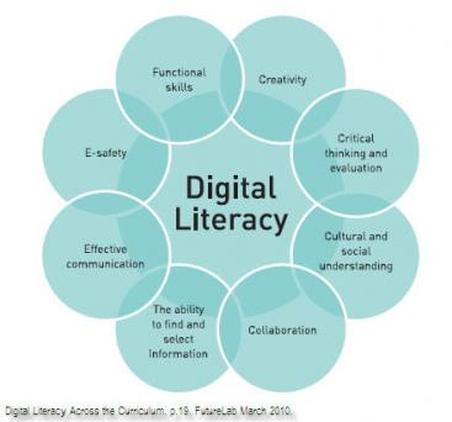
As you can see, digital literacy encompasses many concepts and skills. What teacher has time to introduce all these ideas and effectively teach students the ins and outs so that his/her students are truly digitally literate? But if it's a team effort, something the whole school takes on, then it becomes within the realm of possibility. If it starts early in a student's life, the skills can be reinforced and refined throughout their schooling.
"It is important to understand that information literacy is best addressed at multiple levels in the education process. Think of reading-comprehension skills that begin pre-K and continue through college lit courses. The skills are built upon with appropriate instruction at each stage of learning. This is also the ideal approach to information literacy skills, introducing the skills in the early years, building on them as the student advances through elementary school, and introducing new concepts of knowledge-seeking and analysis through middle school, high school, and post-secondary education." Averill, Debe, and Nancy Lewis. "Students and Information Literacy: High School and Postsecondary Perspectives." Maine Policy Review 22.1 (2013) : 114-117, http://digitalcommons.library.umaine.edu/mpr/vol22/iss1/28
It's not difficult to incorporate technology into the lesson plan. All the research shows that teachers must meet students where they are at; our students are digital natives so it makes sense to use technology to reach them. Blogs, web pages, email and video chats, Facebook pages, writing, illustrating and publishing stories, weekly discussion questions, etc., there are a million ways to use tech in the classroom. Digital literacy is not confined to the language arts classroom, either.
 http://purposefultechnology.weebly.com/how-can-we-embed-digital-literacy-in-the-classroom.html
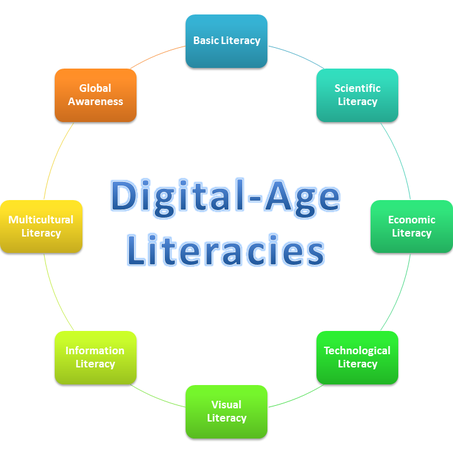
These literacies match up with the traditional math, science, social science, and humanities classes. Within all these curriculums there is a place to teach digital literacy, as we want our students to be critical thinkers who can evaluate the validity and reasoning of the information they seek. In every grade level of the Common Core State Standards students are expected to use a variety of digital tools to create and publish their writing. NETS has 6 categories of technology standards that include all the elements of digital literacy. These skills are already part of our objectives and learning targets. But by going digital this is a vast change for any teacher who is not a digital native. Watch this video to get motivated to work with your students!
https://www.youtube.com/watch?v=Mirxkzkxuf4
"
The purpose of media literacy education is to help individuals...develop the habits of inquiry and skills of expression they need to be critical thinkers, effective communicators and active citizens in today's world."
( Media Literacy as Literacy for the Information Age, Renee Hobbs, Ed.D. Temple University, Philadelphia PA. CRITICAL LITERACY FOR ADOLESCENTS ROSE STATE COLLEGE PROFESSIONAL TRAINING EDUCATION CENTER OKLAHOMA CITY, September 19, 2008 )
This should be the mission statement of my high school. Times have changed and the purpose of education needs to change as well. How can we do this? Bringing in contemporary media and popular culture to our classrooms will deepen engagement and increase motivation, the research shows. Students learning multimedia production can apply some of the same rhetorical devices and skills as in traditional writing classes. Media and/or digital literacy can improve reading comprehension. There are questions, still, about digital literacy. One of the most important is: What instructional approaches using online sources and popular culture are most effective in improving reading comprehension and writing skills?
Research still needs to be done in this field...